

Our History
The story of the Lower Trinity Basin Chapter began with dedicated naturalists, early training classes, and years of shared work before the chapter was officially formed in 2017. This page preserves those roots, the people who built the chapter, and the milestones that continue to shape it today.

How It All Began
The best stories are often told by the people who lived them. Karen Morris shares the chapter’s beginnings in her own voice, preserving the memories, the uncertainty, and the heart behind how it all began.
How It All Began
Bumbling Our Way to Bee-coming a Chapter
“We had no idea what we needed to do. We read the state documents and tried to follow them.”
In January of 2016, Mary Pearl Meuth came down from College Station to help deliver an informational meeting for interested individuals on the Texas Master Naturalists Program.
Roy Flora was a brand new Agrilife Agent and encouraged Laurie Gonzales to get the project started. If you know Laurie at all, you know she took that and ran with it.
Doug and I had been living in Liberty for a little over six months. In April, I saw a small paragraph in the Gazette that mentioned an informational meeting about some nature group being formed. I thought it would be interesting and a good way to meet some people. I convinced Doug to go and we spent a couple hours at the Trinity River National Wildlife Refuge where we learned about Texas Master Naturalists.
It sounded really interesting and we came back for the next meeting and the meeting after that. Laurie Gonzales, Bonnie Campisi, Shelli Ellerbe, Ceal Stirling, Jim Harlow, Doug and I were the nucleus of the group. In a very short time I was taking notes so we’d know what we talked about at the next meeting.
Laurie served as the President, Ceal Stirling as the Vice President, Shelli Ellerbe as the Treasurer, and I took on the job of Secretary. The seven of us became the Steering Committee.
We had no idea what we needed to do. We read the state documents and tried to follow them. We discovered several Catch-22s in the documents, like you have to open a bank account to become a chapter, but to open the bank account we had to already be a chapter.
We kept trying and in November of 2016 we got lucky and Kelly Norrid came to the meeting and we got some guidance. The Gulf Coast Chapter pitched in to give us advice in December and also gifted us with a $500 donation to help us get started.
Somehow, as we were trying to get organized over six months, we were also trying to put together our first training class because that was another thing we had to complete to become a chapter. Laurie and Bonnie spent vast amounts of time at their jobs at the Refuge working on the details of getting things together.
How Did We Do It?
From Early Exploration to Official Charter
“We pulled off a miracle and started our first class in January 2017 with 17 in the class.”
Stuart Marcus, then the Refuge Manager, was very wise to see the value in the Master Naturalist program and allowed Laurie and Bonnie to spend many hours working on Master Naturalist activities. Over time his investment paid off, as chapter members contributed labor to his many community projects. (And now we’ve welcomed Stuart into the chapter in this most recent class.)
Bonnie waded through the morass that was—and still is—the VMS system. Laurie, Shelli, and I read the documents over and over.
We contacted people we thought could teach our classes. Laurie and Bonnie got the word out by radio and local newspapers that we were starting a class in January 2017.
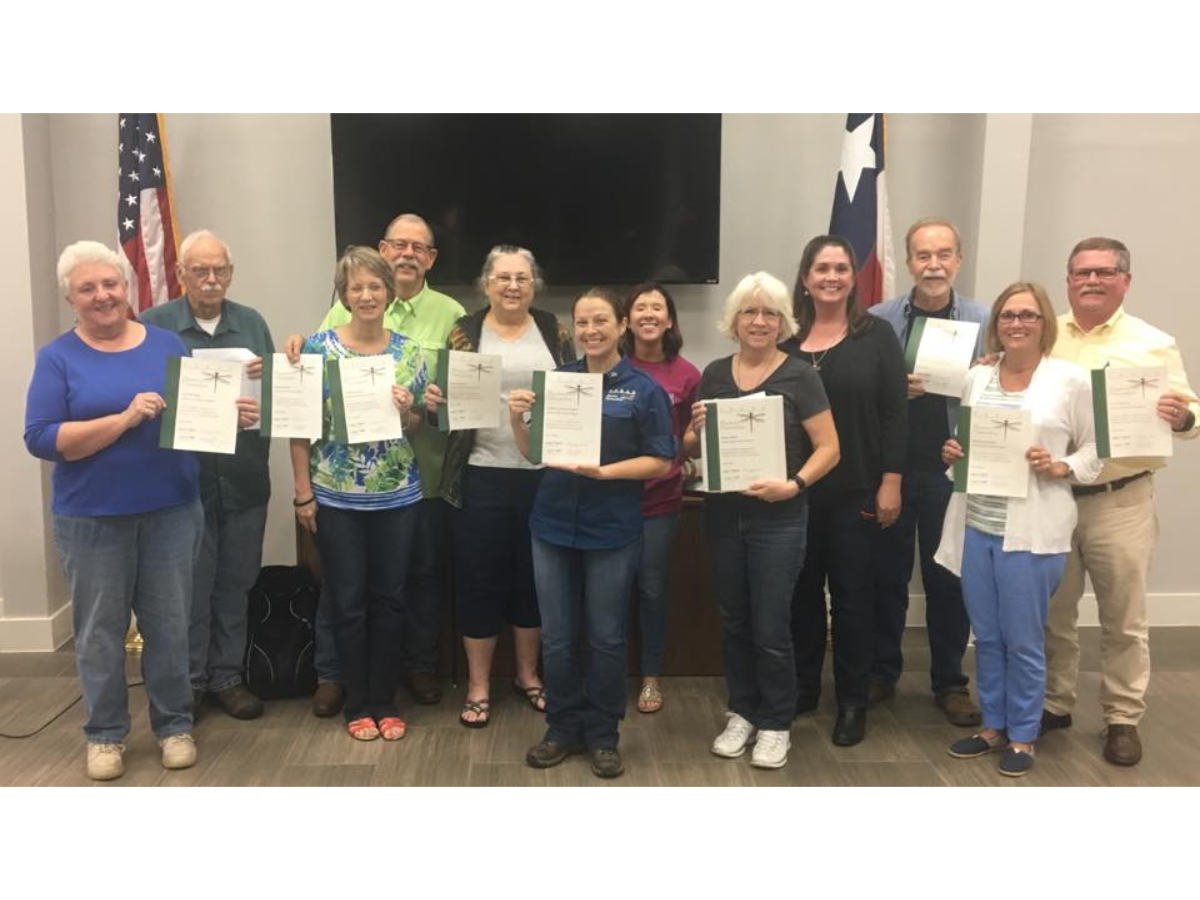
We pulled off a miracle and started our first class in January 2017 with 17 in the class. That number included all of us. We met at the Refuge office. The people who signed up for the class were under the impression that we knew what we were doing. That was definitely a case of faking it.
We had several field trips. The trip to Davis Hill with Kelly Norrid was particularly interesting. It’s a state park but not open to the public. We saw the Raffinesque Big-Eared bat colony that same day. There was also a day-long trip to the shore and the infamous “Death March” to the Trinity River (that’s a whole different story).
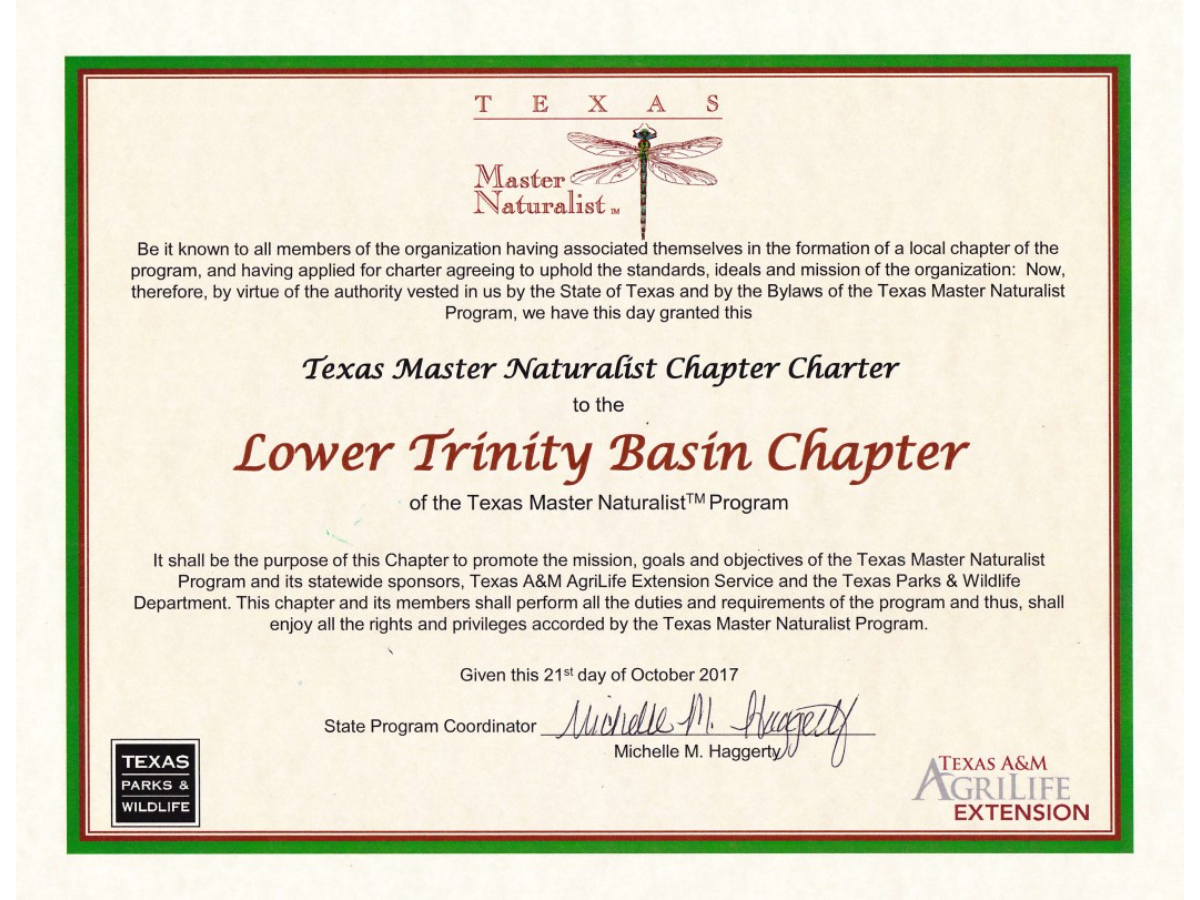
We finished the class in April and by July we were an official chapter.
We elected our first officers. Carl Poldrack, as President, has been a true blessing in getting some important basic documents put into the operation of the chapter. Mickey Redus, as Vice President, has found us great speakers month after month. Shelli Ellerbe keeps track of our funds. I try to get the minutes put together accurately so that if for some reason we need to know what we did a few months ago I can supply that information.
In October more than half of the chapter members went to the State Conference, which was held in Corpus Christi. Percentage-wise we had the best attendance at the conference. The very talented Redus family produced a video of our fledgling chapter that won first place at the conference, and Mickey Redus also won the award for best sculpture.
Our second class met at the Lee College Liberty campus and began in June 2018. We had field trips to the Big Thicket, to Anahuac, and to Sheldon Lake State Park. The third class started in May 2019. Again we had great field trips.
Our fourth class began in February and was the class affected by the Covid-19 quarantine. Starting in mid-March they had virtual classes. No field trips for this group yet, but the day will come when they can get together and get out in the field.
Between hurricanes, Covid-19, and tropical storms we’ve had some challenges. But the chapter has grown with wonderful people who are truly dedicated to caring for our planet. We’ve all become friends. We work on projects together and by ourselves.
The seven of us who worked to get this all started are proud and happy to see our little chapter blossoming and becoming an important player in Liberty and Chambers Counties in the projects we’ve developed and those we are now asked to do.
Moments Through the Years
A look back at the people, places, and milestones that helped shape the Lower Trinity Basin Chapter.


Milestones
Laying the Groundwork
“We had no idea what we needed to do. We read the state documents and tried to follow them.” — Karen Morris
A small group of dedicated volunteers began meeting, learning the program, and working through the many steps
required to build the Lower Trinity Basin Chapter from the ground up.
Planning a Native Arbor Day Project
Laurie Lomas Gonzales helped lead efforts to organize a Native Arbor Day project for the community.
“An Arbor Day is not a one day project. Prior to planting, a year of investment goes into the project,
but the benefits last a lifetime. A project to be planted in November 2020 actually starts in October 2019.”
— Laurie Lomas Gonzales
Texas Monofilament Recovery & Recycling Program
Chapter members helped support the Texas Monofilament Recovery and Recycling Program, removing discarded
fishing line from waterways and protecting wildlife.
“I was at the shore end of the pier, emptying a fishing line recycling bin as part of the Texas Monofilament
Recovery and Recycling Program.” — Mickey Redus
Continuing the Story
Through storms, change, and challenge, the chapter continues to grow through service, friendship, and a shared commitment to caring for the natural world.
Videos from the Chapter’s Early Years
Two video snapshots from the chapter’s beginning, capturing both recognition and celebration in 2017.
2017 State Conference – Award Winning Video
Award‑winning video story of the Charter Class of the Lower Trinity Basin Chapter of Texas Master Naturalists, presented at the 2017 Texas Master Naturalist State Conference.
Initial Training Graduation – 2017
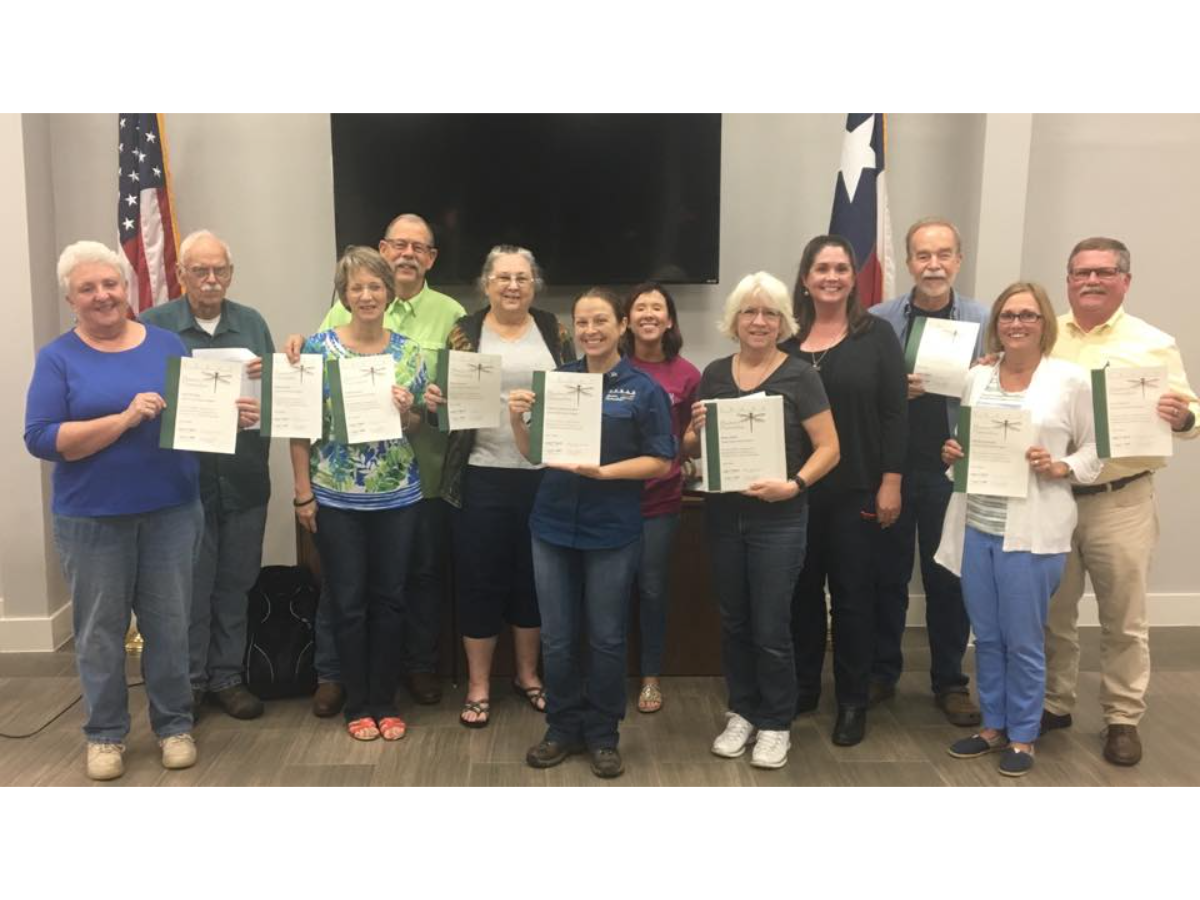
Texas Master Naturalist Program – Lower Trinity Basin Chapter. Celebration of the chapter’s first training class graduation in 2017.
Still Being Written
The chapter’s history includes both its early roots and its official formation. Preserving both makes the page more accurate and gives future members a clearer picture of how the chapter came to be.