


Field Trip Surprise! by Cindy Frank

Several weeks ago, Rae Mooney (the manager of the Port A Nature Preserves) asked if I might be able to help with a Thursday field trip. She said a maximum of 20 kids would be there, and they would like to learn about birds.
Since I’m in Port Aransas on Thursdays anyway, I told Rae I would help. (Grace Lopez has taught me the formula S x 4 + B = ID and I’ve figured out you can adapt that formula to just about any age. But just in case, I asked Ann Flanagan {a retired elementary teacher} to help too.
This past Thursday was the day of the field trip. When I talked with Rae that morning, she told me she had done some more research about the kids coming. She knew they were from the Kerrville area; she knew there were only 20 kids in the whole school district; she knew the ages ranged from Pre-K through 6th grade. She had looked at Wikipedia the night before, and told me that they had a limousine for a school bus! She was totally intrigued and said she was going to ask if that was really true.
When Ann, Rae, and I arrived at the Leonabelle Turnbull Birding Center parking lot, a charter bus was parked there. Kid after kid emerged (all looking very young) and then adult after adult. One man walked up to us and asked if we were there to teach birding. Rae said we were, and she immediately asked him if it was true about the limousine. The guy said, “Yep. It is true. And I’m the driver. I’m also the principal. I’m also the superintendent.” (The man’s name was Bill Bacon)
Turns out they did bring every single student that day – 20 total – and there were 25 adults with them. The kids were the most polite and attentive kids I’ve ever worked with! They listened to every word, even with distractions like the alligator, and they all made a point to thank each of us at the end.
Rae did even more research on the school, and it turns out that Texas Monthly ran an article about it in 2015. I’m going to cut and paste some of the cool stuff from that article below.
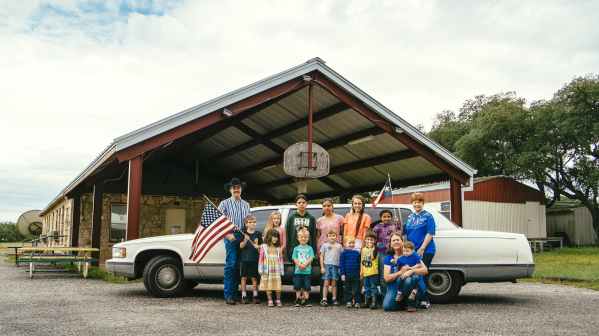
“At Divide School, outside Kerrville, the third graders sit in class with the sixth graders, the superintendent is also the repairman, and recess can mean hopping over cow patties.
Thirty miles northwest of Kerrville, the hills begin to roll over the Divide, a five- to fifteen-mile-wide ridge that dissects the watersheds for the Llano and Guadalupe rivers. Save for the steel or stone ranch gates along the area’s two-lane highways, leading to the homes of descendants of the families who first settled the area, there aren’t many reminders of history here; it’s bluestem grass and live oaks as far as the eye can see. But on one rise, a small stone structure usually does draw curiosity: a 1936 schoolhouse…the school district, the smallest in Texas by population, serves families whose fates are inextricably tied to the land. Children of ranch hands don’t always stay, and they are often replaced by new arrivals, so that when asked about enrollment, Bacon had to try to reconstruct the year. “Let’s see,” he said, closing his eyes, “we started with eight, then we had nine, then eleven, then back to nine, then ten, then back to eight, then back to eleven.”
Bacon has run the Divide Independent School District, which consists of only elementary grades, for seventeen years. More specifically, he has been the superintendent, the principal, the third-to-sixth-grade teacher, the ESL instructor, the special-ed teacher, the repairman, the contractor, and the transportation director for the “bus,” which is actually a white limousine he purchased for a steal from a dealer in Dallas. He is not the only employee—there are four others, including two pre-K teacher’s aides, a kindergarten teacher who also teaches first and second grade, and a secretary—but he is the most involved. He is tall and skinny, with a graying mustache in the shape of a horseshoe, and when he’s talking, he hooks his thumbs in the pockets of his starched Wranglers. He keeps his cellphone in a belt holster. It almost goes without saying that on most days he wears a white straw hat to school, which sits on his desk while he’s in the classroom.
Bacon shares the values of the area ranchers and their hands, stressing hard work and pride in a job well done. He’s long on praise, especially if a student is exerting effort (“Oh, that’s a good sentence,” he’ll say. “I like that sentence right there”). He’s not above teaching practical problem-solving, as he did one day when he asked the upper grades to replace a doorknob, and like all good teachers, he draws on ideas that his kids can relate to, whether that’s in mnemonic devices (“She’s a pistol-packin’ mama” to remember the female part of the plant) or math word problems (“If sweet feed costs fifty cents . . .”). He’s also big on manners. Early in the school year, he asked a second-grade arrival from Kentucky if she was done with her work, and she turned her paper toward him to show that she was. He raised his eyebrows, then whispered with a wink, “It would have been just as easy to say, ‘Yes, sir.’ ”
The Divide School isn’t technically a one-room schoolhouse. People sometimes refer to it that way because the upper grades hold their classes in the district’s original single-room building, a 79-year-old stone structure… …since opening, its superintendents have undertaken multiple renovations, installing electricity, cutting the single room in two, adding a small library and a reception area, and erecting a separate building for pre-K out back. A few years ago, when the student population exploded to thirty, Bacon wrangled a few used portable buildings. Now that enrollment is back down, following a decrease in local ranch employment, one of them hosts the younger grades and the rest are mostly used for storage.
Divide receives a small guaranteed amount of money from the state, but like all schools, it also receives a crucial portion of money per pupil. And there will always be unforeseen events to contend with, like when the ceiling needed replacing one summer or the alternator on the limo burned out last fall.
Bacon wasn’t always a teacher. He used to own a roofing company with his brother in Kerrville, a healthy business until a storm ravaged the area and resulted, a year later, in new roofs for everyone—and no more repairs for the brothers to do. Bacon, who had a finance degree, considered becoming an insurance adjuster, but it didn’t fit his personality. He liked helping people in unexpected ways. “All the time I was in the roofing business, I was a banker, a marriage counselor, a bail bondsman,” he said. He wondered if he could make a difference in others’ lives if he caught them before they went into the workforce. So at age 31 he went back to school and got a teaching certificate. He started out in special education in Hunt, slowly taking on more responsibilities, until he was asked to oversee the Divide School, in 1998. “I lived at the school—I put in the hours,” he said. “It’s a lifestyle, and for me, you know, it’s kind of like my own business. You take a guy who works for himself, a guy who owns his own store: he doesn’t work eight to five. When something needs to be done, he does it.” If the urinal in the boys’ bathroom breaks, Bacon knows what he’s doing that weekend.
The closest elementary schools are at least thirty miles in any direction: Ingram and Harper to the east and northeast, Leakey to the southwest, Junction to the north. Still, Bacon has felt the threat of closure. Back in the early aughts, during a winter break, he was at school when he received a worrisome call. “The phone rang, and this old boy said, ‘Mr. Bacon?’ I said, ‘Yessir.’ He said, ‘My name is Will Counihan, and I’m with the state comptroller’s office.’ Well, it’s never good when you get a phone call from the comptroller’s office; they’re not wanting to chitchat. There was a problem. He said, ‘We’re going to come to your school with a team of twelve to fourteen people, and we’re going to look at every aspect of your district: the finances, the special education, the education services, the bilingual program, the food services, the transportation, and your federal programs.’ Then they asked, ‘Do you have any questions?’ ” Bacon’s voice squeaked as he continued, trying to contain the laughter creeping up his throat. “I said, ‘Yes. Why am I so blessed?’ ”
When his visitors arrived—in the end, the group had been reduced to seven—Bacon sat them at a half-moon table and answered their questions with rapid-fire delivery. “They said, ‘We want to talk to your principal,’ and I said, ‘Well, I am the principal.’ ‘We want to talk to your superintendent.’ ‘Well, I am the superintendent.’ ‘Where’s your maintenance director?’ ‘Well, I am the maintenance director.’ ” His inquisitors were so impressed with him that they left the school open. “ ‘Every single person on our team was planning on closing this school,’ Mr. Counihan told me, ‘and the consensus was—and it was one hundred percent—that the state of Texas would be better served to consolidate you with another district. But after being here, not one person is in favor of that.’ ” Bacon smiled at the memory. “Of course, that was music to my ears,” he said. He thought about it for a second. “The visit could have been a curse, but as it turns out, it was the most wonderful thing that could have happened to me.”
(Texas Monthly interviewed a parent, too) She can’t imagine how her kids would handle themselves in a city. “We’ve never had a neighbor,” she said. “The worst thing is a snake, not a car. You have to learn your town voice too; you can’t just go hollering. And learning to cross the street—that’s a big deal.
(Texas Monthly ended the article with this, talking about graduation) That evening, the kids would all receive their certificates, as well as medals. Bacon, reminiscing about the year, would pull forward the only graduate who was leaving. “I’m going to tell you, Caroline, we’re going to miss you next year,” he would say as his daughter approached the stage, her face wet with tears. She was headed off to middle school in Harper, forty miles away, where Bacon’s wife, Cindy, is a teacher. “Don’t worry, we’re going to write you letters. We’re going to get that boarding school’s address in Switzerland.”
Like Rae, I was impressed before reading this article. Afterward, I now know why these kids said please and thank you and minded their manners. I feel very lucky that Rae asked me to lead this field trip for Mr. Bacon and The Divide School!