
Submitted by Tee Roberts, Class of 2026
I am a data nerd by profession, and also a lover of all things reptile. (I dedicate this article to my favorite snake, Gojira, a beautiful ball python who enjoys resting in his rock hide and climbing his log. Bonus points if you know what his name means. As I said, I am a lover of all things reptile.) At any rate, one of the best sources for reptile data happens to be our beloved iNaturalist app. And it is surprisingly easy to pull data from there. So, I decided what better way to demonstrate my love for reptiles than to download and play with snakes…er I mean snake data. More specifically, the Eastern copperhead aka agkistrodon contortrix.
For the first part of the project, I looked at the comments and descriptions left by users who spotted our favorite snake while out and about. I sorted the key words in those comments and descriptions into clusters to see if there were any notable trends, and there were a few. Based on a word cloud I did I noticed the phrase “northern copperhead” came up a lot, so I went digging. It turns out there used to be what was considered a subspecies of copperhead called the northern copperhead, however that is no longer accepted as a separate species. The state of Virginia came up quite a bit so we know there must be a healthy copperhead population there, and we will discuss why later in this article.
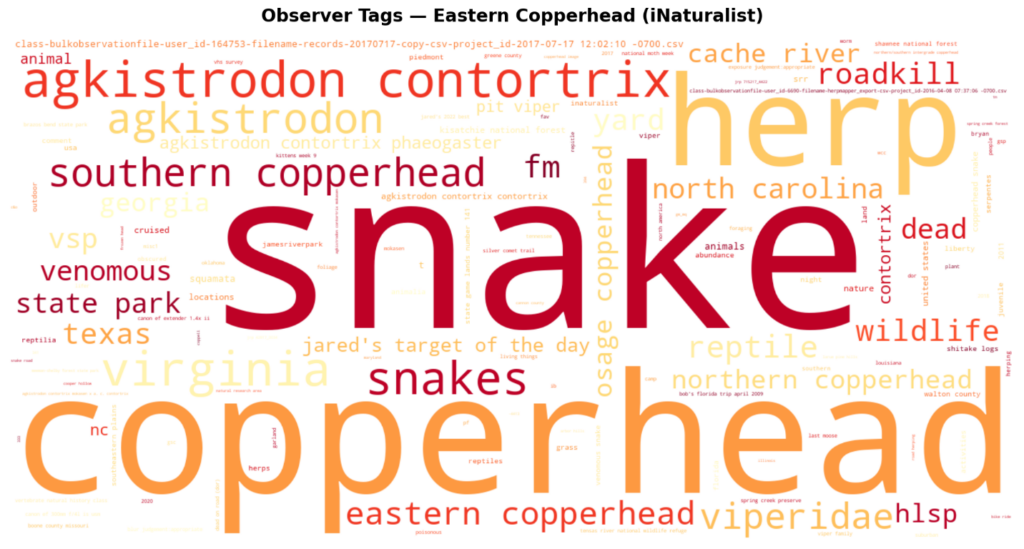
One cluster contained several references to “dead” or “dead snake” but also contained several references to “car.” This suggests that there is a decent portion of eastern copperheads who are struck and killed by cars, most likely when trying to cross busy streets or highways. This brings up a memory from when I lived in Ohio, I was about to get on I-75 and right at the exit ramp, an Eastern box turtle (best guess) was trying to cross the ramp. Our highways are often flanked by heavily wooded areas, and no doubt this little friend was just trying to get back to the coverage of the trees. I stopped my car, jumped out, and carried it across the ramp to the woods. (That was a pretty busy exit ramp, and I did not want it to get hit.) Obviously, we should not repeat this behavior with copperheads (they are venomous after all) but maybe we can be more mindful when driving through heavily wooded areas.
A final note on my word clusters, I also noticed several references to yellow or green tails. Hmm, said I. “What could this mean?” So, I did a little digging and learned that a common prey for juvenile copperheads is lizards. And these juveniles often have bright green or bright yellow tails which they use as lures to attract this prey. I do not know if this is a common practice for snakes, but it is seen in other parts of the reptile world. The prehistoric beasts known as snapping turtles have been known to wiggle their tongues while underwater to act as lures for poor unfortunate fish that happen to swim by.
After the word analysis, I tracked sightings trends by hour, month, year, and I also used an API from a company called Open-Meteo which has readily available weather data. I matched that with the sightings from iNaturalist to figure out when copperheads are most commonly seen. I will say the yearly data was perhaps not that useful, given that the records begin in the 70s when iNaturalist was not the juggernaut that it is today, and so even though the data shows an increasing number of sightings it is hard to say whether that is because the population of copperheads is actually increasing, or if it is simply because iNaturalist is being used more to record the sightings.
What the data does show is that our slithery friends tend to be highly active from about 8am to 11am and again around 7pm – 8pm. This might suggest a crepuscular schedule (active at dawn and dusk), but what I learned is copperheads actually change their behaviors based on the seasons. The warmer it is, the more likely they will be active at night. As the weather cools, they become more diurnal, that is, active during the day. (As Spock would say, “Fascinating, captain!”) They are least active in the early morning (1am to 5am) but maintain various degrees of activity throughout the day.
Another thing of note, our scaly buddies tend to be seen most around May and September. There could be several factors for this. In Texas, May and September are migratory primetime for birds. Given that birds often time movement to their food cycles, it is reasonable to suggest that there is likely a high insect population around those times. And given that copperheads eat both insects and birds, it makes sense that they would pop up around migration season. And there are much fewer sightings in deep winter. Given that many reptiles enter brumation (a bit like hibernation, but the animals remain awake) around that time, it makes sense that we would not see very many of them. Snakes do not like to be cold, at least I know mine does not.
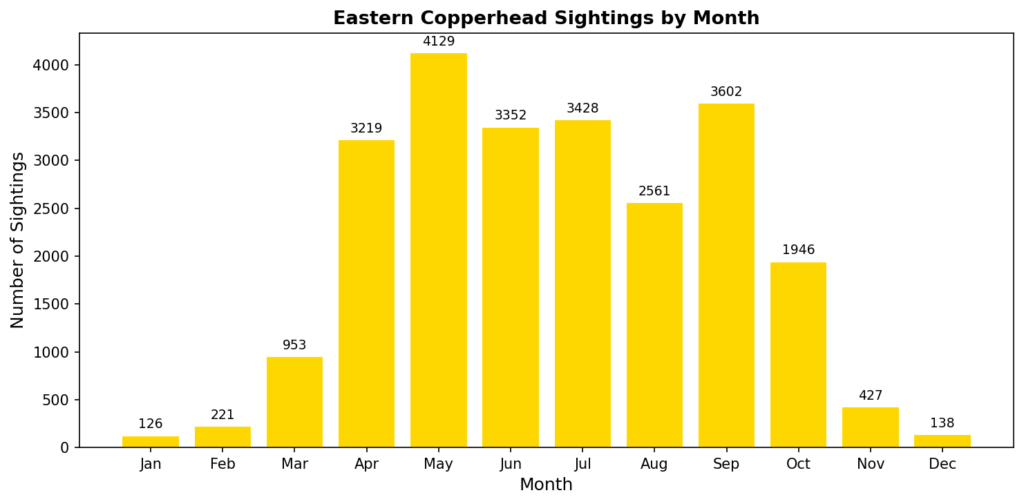
And finally, let us talk about weather. Using the data from Open-Meteo and matching it to the dates of our sightings we find that copperheads are often seen during rain and drizzle. This kind of matches with our monthly sightings data, at least in Texas. We know May and September tend to be a bit rainy, so that further explains why May and September have the most sightings. There are a couple of theories behind this. One is that snakes are often pushed out of their underground burrows by flooding and are often seen seeking higher ground. Another suggestion is that after the rain, snakes emerge to bask and warm up.
(An interesting question following the weather data, we know when prairies are removed, that flooding can increase and have harsher effects. If increased flooding forces snakes to move about seeking higher ground, does this then make them more likely to be killed, either from getting hit by cars, or killed by confused humans who do not realize that an alive snake is actually a GOOD thing. Aside from insects, our scaly buddies love mice.)
Ok, sorry, one more thing:
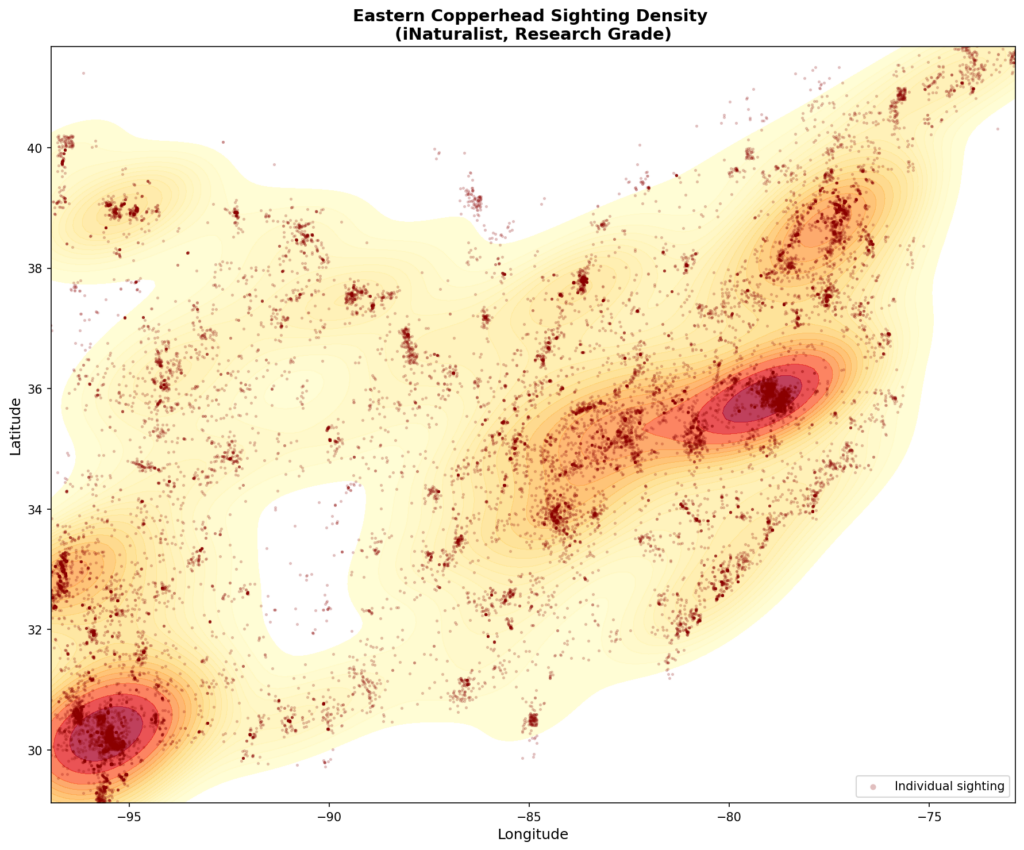
See those two big blobs that look like the fiery version of a black hole? Guess where they are? Remember how we kept seeing Virginia on our word map? Yep, the northern blob is the border between Virginia and North Carolina, prime Appalachian/Blue Ridge territory. The southern blob is the Piney Woods region north of Houston. These are both heavily wooded areas with tons of ground cover, which apparently copperheads love. If you look at the picture at the top of this article (taken at Cedar Ridge Preserve) you will notice that our friend blends in pretty well with the dead leaf litter. Perfect for ambush hunting and not getting stepped on by clumsy hoomans.
Now, a disclaimer. I am not a Ph.D.; I just really love snakes. The point of this article is not to suggest hardcore facts but more to delve into animal behavior and what we might learn from it. It also serves as an example of how REAL scientists might use citizen data, combined with other sources, to come to conclusions about the natural world. It is such a fascinating place, and there is so much to discover and learn, and I want to thank our friend, the humble copperhead, for providing us with this wealth of data. Once again, let’s hear it for the snakes!