


Randy Boys, Blackland Prairie Chapter, Texas Master Naturalists, Class of 2023
Introduction: A Collector’s Journey
There are two things about me that frame what I want to share about collecting—especially opals—in North Texas. First, I’ve been collecting things since I realized my pants had pockets. Even early on, rocks (and later, minerals) were some of my favorite targets for searching, collecting, studying, and organizing.
Early Rockhounding Adventures
As a child, I was a frequent visitor to rock shops in upstate New York. The region, with its rolling hills, ponds, lakes, streams, and fascinating geology, offered igneous, sedimentary, and metamorphic rocks—often mixed in the glacial moraines. There’s always bedrock somewhere, and ways to access it. Before I was a teenager, I became the first junior member of the Rochester Mineralogical Society. It felt like gaining 50 grandfathers willing to share their collecting secrets and drive me to meetings. I bought my first collecting guide at age seven or eight, and received a big glossy coffee table book about minerals at nine.
Why Opals?
I love opals. Maybe it was the fancy Australian black opals in that coffee table book (which can cost more per carat than diamonds), or the fact that opals are my birthstone, or their mesmerizing, ever-changing beauty. The main attraction is that people worldwide do find opals in non-commercial settings. I wanted to be one of those people, even if there were no opals within hundreds of miles of where I lived. (And I will make it to Australia someday!)
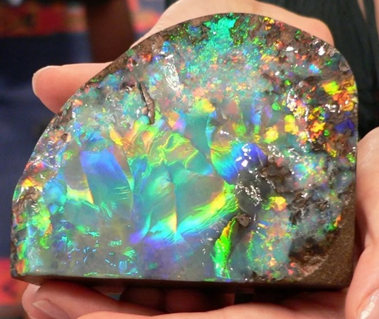
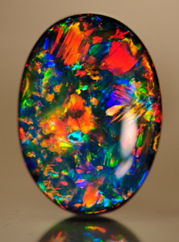
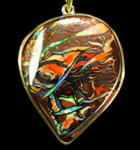
Opals in North Texas: The Truth
Unfortunately, there are no gem-quality opals within a few hundred miles of North Texas. For any you might call “My Precioussss,” you’d have to go about a thousand miles—to Idaho or Nevada, with a few lesser finds in Colorado. So why the title? Because we do have some critter-made near-equivalents. The mechanisms of light-shifting iridescence and multi-color diffraction are similar in opals and in beetle shells or butterfly wings. I hope you’ll enjoy sharing these mechanisms and some of my favorite photos.
Bugs First, Then Rocks
Compared to bugs, birds, and trees, rocks and minerals can hold their own in most naturalist venues. However, only a handful of us in the Blackland Prairie Chapter might entertain that argument, and most would quickly shift to fossil records or soil chemistry. For me, it was always the shiny or curious little “thing” that could be separated from the chaff. While the thought of “little Randy” collecting cans of different dirts is entertaining, it didn’t happen—at least not until much later.
Responsible Collecting
Rock collecting, or even photo collecting, should be done in ways that don’t disturb the environment or compromise future visitors’ experiences. While it’s impossible to collect rocks and fully meet Leave No Trace guidelines, there is good collecting and bad collecting. Here are my two rules:
- Don’t do work someone else has done for you.
- If in doubt, take it home.
For rockhounding, this means finding quarries, construction sites, creekbeds, or mine tailings—places where disturbance has already occurred. For plants, insects, or birds, it’s about finding good habitats or asking friends for tips. For all collecting, take lots of photos, keep a journal, and sort things out at home.
Opal-Like Iridescence in Animals
My favorite animal specimens with opal-like appearances are found in the chitin of beetle exoskeletons. Many people are familiar with the metallic shines and changing hues of butterflies, or even fly and wasp wings. But beetles (order Coleoptera) are the true title holders, with 400,000 known species and possibly up to 1.5 million.
Elytra Embroidery: Fashion and History
A century or two ago, iridescent beetle exoskeletons were well-known, especially in the Indian subcontinent and Victorian England, where “elytra embroidery” was fashionable. Elytra are the iridescent chitin wing covers of beetles, used as adornment for millennia and still in use today. The required hand embroidery favored expensive evening wear, and many pieces are stunning.
Terminology: Metallic, Iridescent, Luster, Opalescent
- Metallic (in appearance): Shiny and reflective, with color and shininess not dependent on light intensity or angle.
- Iridescent: Colors change with viewing angle or lighting, like the surface of a soap bubble.
- Luster: The general appearance of a surface’s sheen—can be metallic, silky, greasy, translucent, sparkling, or iridescent.
- Opalescent: Iridescence associated with reflected light, often diffuse and glowing, as seen in milk glass or common opals.
The Science of Color and Luster
Is a monochromatic, vibrantly metallic exoskeleton that changes color with viewing angle opalescent? I’d say no, but that’s just my opinion. There are similar optical properties in fluorescence, which I’d love to discuss another time.
Chitin: The Biopolymer Behind the Shine
Chitin (pronounced KAI-tn) is a biopolymer made by living things, second only to cellulose in quantity. Its layered structure gives strength and optical properties. For example, a butterfly wing is only two molecular layers thick, while a beetle exoskeleton may be five or six layers. Additional proteins or inorganic crystals can be bonded for more strength or thickness.
Optical Properties in Insects
Butterfly wings, with only a single molecule-thick layer of chitin, don’t offer much opportunity for light to bounce and create iridescence. However, the scales affixed to the understructure are also made of chitin and programmed for optical effects—camouflage, sexual dimorphism, mimicry, signaling, and more. Examples include the “eyes” on Buckeye butterflies or Luna moths, and the wings of the Black Swallowtail.
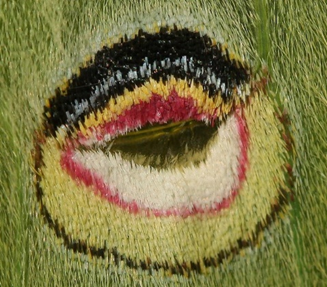
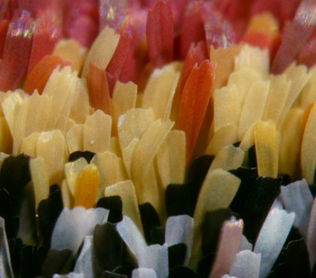
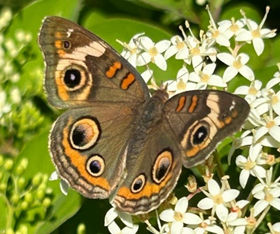
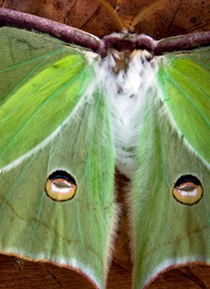
The photos of scales aren’t mine (but are public domain), and the Luna eyes do shimmer like the Buckeye’s, but I didn’t include a photo demonstrating that.
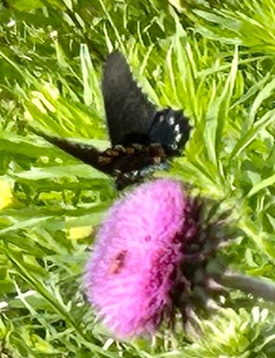
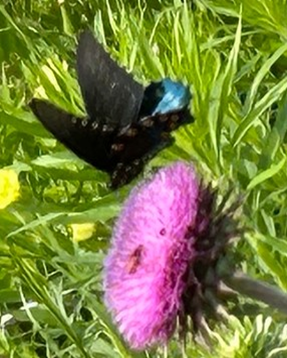
Minor change in angle, big change in coloring
Reflective Surfaces in Nature
Butterflies can achieve a reflective surface nearly as shiny as polished aluminum, using organic processes. Scientists have even engineered plants to express similar reflective properties, which could help crops adapt to climate change by reflecting sunlight and conserving water.
Physics of Intense Color
The intense colors in beetles come from multi-layered chitin, which allows constructive and destructive interference of light waves. This mechanism works better in beetles than butterflies, creating brighter or darker patches depending on the incident light. Thin film interference, as seen in soap bubbles, is a commercial application of this principle.
Chitin vs. Keratin
Chitin is the polysaccharide polymer of interest in insects and crustaceans, while mammals use keratin (hair, nails, feathers, skin). Plants perform similar photonic magic through different mechanisms, and human intervention can create hybrids.
Beetles: Nature’s Living Opals
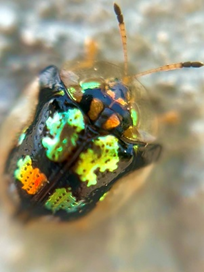
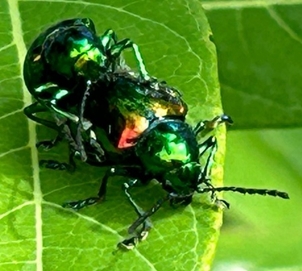
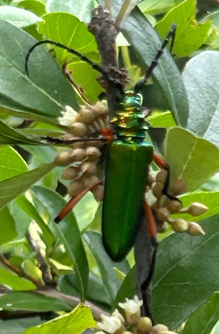
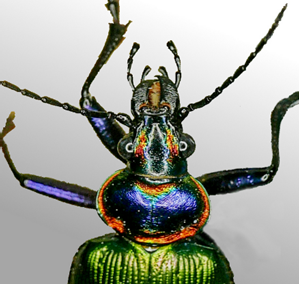
Here are some of my photos of beetles that are particularly opal-like. These “Australian blacks” are brilliant, multicolored, and intensity-amplified. Move a hair and they change or go dark. I’ve yet to see a second tortoise beetle look quite like the first one I found.
Other Opal-Like Insects
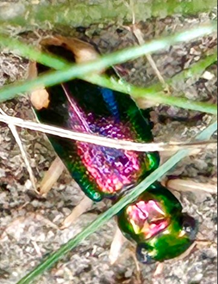
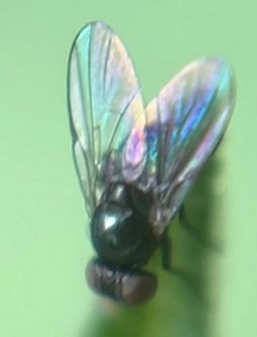
The next set of insects are still “first-tier precious opals,” showing a good spread of changing color from a single viewing angle. The Scrutator picture isn’t mine, but we see them often when mothing.

Opal vs. Chitin: Key Differences
Opal is an amorphous (non-crystalline) form of quartz, with water bound into the matrix. It’s not a true mineral, but a “mineraloid.” Its tiny spheres of quartz and water are layered, causing the play of light. Opals get most of their colors from these layers, but the sphere sizes also matter. Larger spheres at the bottom can produce rare red flashes. Opals are popular for wedding rings but are very breakable.
Optical Mechanisms: Opals and Beetles
Both opals and beetles use layered structures to create color, but opals rely on the size of silica spheres, while beetles depend on the thickness and uniformity of chitin layers. Beetles must grow these structures uniformly, within 20 nanometers, to achieve the effects we see.
Other Sources of Opals
Fire opals from Mexico are prized for their uniform red matrix. In recent years, Ethiopian “Welo” opals have matched the beauty of Australia’s, which previously supplied 95% of the world market. Minor occurrences of precious opal have been found in Arkansas and Arizona, but only massive common opal is likely for collectors. Fossils can sometimes be replaced by opal, including entire petrified wood logs and even opalized plesiosaurs in Australia.
Collecting Tips: Photographing Living “Opals”
I still collect rocks and minerals, but now I let my phone’s camera record living “opals” as I find them. Take lots of photos—the slightest movement can completely alter what you see. Move around and observe how the play of light changes. At night, move your illumination source for better results.
Common but Beautiful Insects
Many spectacular insects lack the iridescence and depth of color of an Australian black opal, but are still beautiful. I particularly fancy the metallic ones, and our trademark TMN dragonfly is strong in both metallic and iridescent categories. Moths are also amazing, and beetles are, in my opinion, the clear winners in the “show-offs with colors and patterns” category.
Final Thoughts and References
Happy not-rockhounding! If you capture an Australian black of your own, let me know.
Thank you for your time. If you made it here, I trust you found it informative. There are dozens of mechanisms of iridescence, and we can only guess how many evolutionary pressures selected for them. For more information, consider the following reference:
Seago AE, Brady P, Vigneron JP, Schultz TD. Gold bugs and beyond: a review of iridescence and structural colour mechanisms in beetles (Coleoptera). J R Soc Interface. 2009 Apr 6. Available through the NIH: https://pmc.ncbi.nlm.nih.gov/articles/PMC2586663/