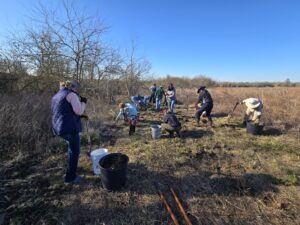


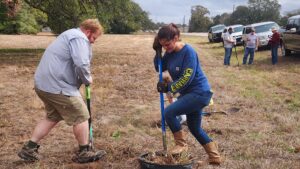
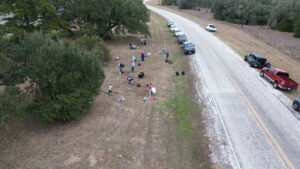
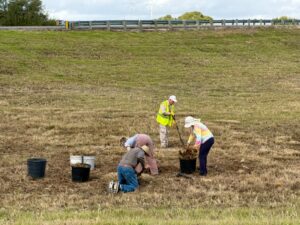

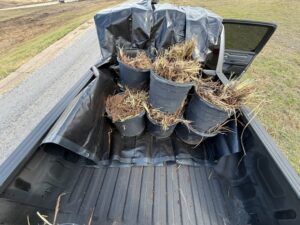
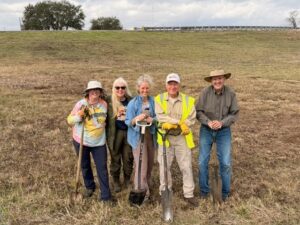
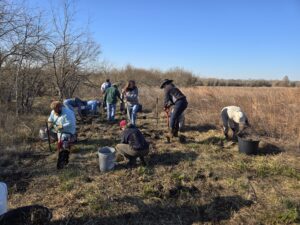


On February 3rd and 4th, in collaboration with members of the Native Prairie Association of Texas (NPAT), TMN chapter members worked to rescue and rehome gamagrass ahead of annihilation via construction. When the news came that construction along I-10 was set to destroy a stand of gamagrass, NPAT was quick to act, and organized this project. Participants spent the first day harvesting gamagrass rhizomes in the Weimar area into large buckets and bags and readying them for transport. On the second day, the gamagrass was planted in two separate areas of the 203-acre Elder Prairie near Chappell Hill.
Participating Texas Master Naturalist Gideon Lincecum chapter members included: Wanda Anglin, trainee Lisa Bexley, CJ Claverie, Marvelyn Granger, Trey Granger, trainee Pam Heard, Cindy McMorran, John Prtichard, Jacquie Pritchard, Dottie Schoeneberg, Katie Tagliavia, and Krystyna Westfield. Everyone involved worked together seamlessly, getting right into the hard work of digging, hauling, and planting. The energy and cooperation made the two days fly by and showed what can happen when people care about the land.
The leader of this project, Native Prairies Association of Texas (NPAT), is a non-profit land trust dedicated to the conservation, restoration, and appreciation of native prairies, savannas, and other grasslands in Texas. Since 1986, they’ve been working to save and steward these special places in Texas. Today, NPAT protects 6,543 acres across the state, ensuring these landscapes remain a haven for diverse wildlife, pollinators, and native plants. TMN member Marvelyn Granger also happens to be president of the Fayette Prairie Chapter of NPAT, which monitors all five of the TMN Gideon Lincecum chapter’s counties (plus six additional surrounding counties).
We were lucky to have Dr. Lynn Loomis out there with our group for both days of the gamagrass rescue. A longtime soils scientist with deep roots in Texas land management and native plant ecology, Lynn was full of insights about gamagrass and the soils it loves, but what really stood out was how hands-on he was. He jumped right in with everyone else, digging, hauling, and replanting, all while happily sharing knowledge and encouragement along the way. A published scientist and award-winning educator, Lynn spent much of his career teaching at Sul Ross State University and brings over 30 years of ecological and soils expertise from his work with USDA-NRCS in the Big Bend region, along with his current work in rangeland restoration across Far West Texas.
If you’re new to Texas Master Naturalists, you might be wondering why this rescue and rehoming project was so important. A large portion of the central United States was once covered in huge swaths of prairie. Unfortunately, due to agriculture production and some urbanization, less than 1% now remains of the original native prairies, making them one of the most endangered ecosystems in the world.
Gamagrass is a resilient native prairie species with a broad range across much of the central and eastern United States, extending into Mexico, the Caribbean, and parts of South America. Its deep roots help it survive drought, improve soil structure, and reduce erosion, allowing it to thrive in challenging environments like streambanks, bottomlands, wet prairies, and rocky sites. Gamagrass also provides valuable habitat and seed for ground-nesting and game birds, and it’s a favorite forage for cattle, often affectionately called “cattle ice cream” because it’s usually the first grass grazed.
Projects like this gamagrass rescue show how much impact a small group of committed people can have when they act quickly and work together. By saving plants that would have been lost and giving them a new home at Elder Prairie, TMN and NPAT members helped protect not just a species, but the living connections between soil, water, wildlife, and people that define our native prairies. In a state where so little prairie remains, efforts like these matter, and they remind us that conservation doesn’t always happen on a grand scale; sometimes, it happens bucket by bucket, plant by plant, with dirty hands and a shared commitment to caring for the land. To learn more about NPAT and find out about future projects like this one, visit https://texasprairie.org/