

• Skip to primary navigation
  • Skip to main content
Lower Trinity Basin ChapterLower Trinity Basin Chapter
  • Home
  • Get Involved
    • Class Schedule
    • Monthly Meetings
    • Contact
    • Donations
  • Newsroom
    • Chapter news
      • Member Articles
      • Projects
      • Speakers
    • Monthly Newsletter
    • Social Media
    • Public Notice
  • Explore The Basin
    • Ask AI
    • Search
    • Collections
      • Space and Time
        • Galaxies
        • Planets
        • Cosmic History
        • Stars
        • Cosmic Scale
        • Night Sky
      • Big Thicket Adventure
        • The Pitcher Plant Trail
        • Big Thicket Canoe Trip
      • The Heart of The Coast
  • About Us
    • Our History
    • How Chapter Projects Work
    • Officers, Directors and Committee Chairs
  • Member Portal
    • Dashboard
    • Operations
      • Chapter Notices
      • Combined Calendars
        • Advanced Training Calendar
        • Chapter Calendar
        • Volunteer Calendar
      • The Events Calendar
      • Reporting Hours
        • VMS Assist
    • Studio
    • Administration
      • Pay Dues
      • Policies
      • Member Documents
        • Training
          • Preauthorization for Training
          • 2024 Training Class Application Letter
          • 2024 Initial Training Classes
          • Other Training Opportunities
Search

The Pitcher Plant Trail

The Pitcher Plant Trail | Big Thicket Field Narrative
Antique-style route map from Houston to the Pitcher Plant Trail in Big Thicket National Preserve

Illustrated field narrative · Big Thicket National Preserve

The Journey

An adventure experienced on May 23, 2026 by Rodney V Franks and Cynthia Franks.

Nearly one hundred miles separated our home from the pitcher plant bog hidden beyond the timberlands of the Big Thicket.

Thunderstorms moved across East Texas throughout the morning as Cynthia and I traveled north toward the preserve. The roads remained wet long after the rain had passed, and the low places held standing water.

Yet by the time we entered the preserve, the trail stood quiet beneath the pines. No rain fell during our guided walk.

93miles by road
2 hrby automobile
1 day 21 hron foot

Arrival at the trailhead

The Guide

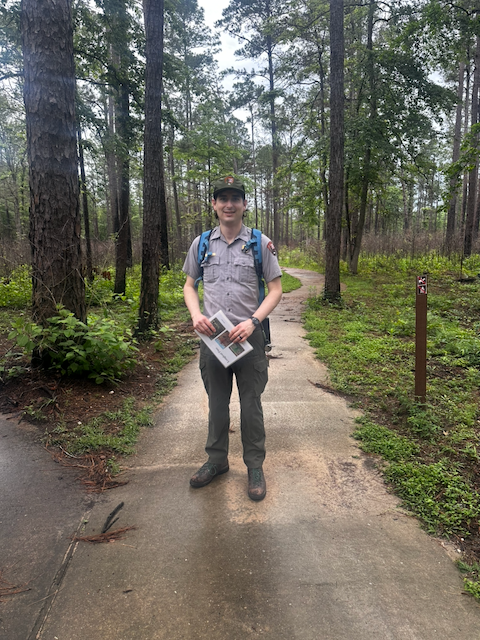
We finally reached the Pitcher Plant Trail and met our local guide, Park Ranger Scott Sharaga, pleasant, smiling, and plainly at home in the preserve.

He carried a field binder filled with photographs and notes from the Thicket. The trail behind him looked modest at first: wet pavement, longleaf pines, and a narrow path vanishing into humid green shade.

Scott explained that the landscape changed quickly ahead. The plants we had come to see survived in places where the soil offered little, where water and sun created a narrow world for specialists.

Trail sign for the Pitcher Plant Trail in Big Thicket National Preserve
The sign at the threshold: ordinary wood, wet pine forest, and a trail leading toward an unusual bog.
Park Ranger Scott Sharaga in Big Thicket National Preserve
Park Ranger Scott Sharaga, our guide into the pitcher plant bog.
A bridge on the Pitcher Plant Trail in Big Thicket National Preserve
A bridge on the Pitcher Plant Trail, crossing wet ground on the way toward the bog.

Crossing over

Into the Bog

The shift was abrupt. Pine woods gave way to open wet savannah, and the ground began to show the kind of evidence travelers once feared: saturated soil, shallow water, and plants adapted to conditions that would have delayed any older journey by days.

For us, modern roads, radar, GPS, cameras, and dry clothes compressed the hardship. The wonder remained.

Panorama of the Pitcher Plant Trail bog in Big Thicket National Preserve
The bog opened beneath a gray sky: longleaf pine, wet savannah, grasses, and hundreds of pitcher plants rising from saturated ground.

The hidden small things

Plants That Reward Looking Closely

The first lesson of the bog was scale. The pitcher plants announced themselves from a distance, but the sundews and butterworts required patience. They were easy to step past, easy to dismiss as ordinary green flecks in the wet ground, until Scott pointed out what we were seeing.

We searched for bladderworts as well, but the elusive plants avoided us that day. Their absence became part of the record: observed conditions favorable, guide present, eyes attentive, no bladderworts located.

A group of sundews in Big Thicket National Preserve
Specimen note · sundews

A small group of sundews, their sticky leaves adapted to catch tiny insects close to the saturated ground.

A single sundew in Big Thicket National Preserve
Specimen note · single sundew

A single sundew made visible only by slowing down and looking where the boardwalk met the bog.

A single butterwort in Big Thicket National Preserve
Specimen note · butterwort

A single butterwort, lower and quieter than the pitcher plants, part of the bog’s more secretive company.

A group of butterworts in Big Thicket National Preserve
Specimen note · group

A small gathering of butterworts, easy to miss without a guide and the patience to examine wet ground closely.

Strange ecology

The Hunters Are Also Hunted

The pitcher plants are the obvious marvel: leaves reshaped into vessels, rainwater and digestive fluids below, insects drawn toward a one-way chamber.

But the bog complicates the story. One pitcher showed the work of the pitcher plant moth, a reminder that even a carnivorous plant belongs to a larger food web. The trap can become shelter. The hunter can become habitat.

Attract

Color, scent, and nectar draw insects toward the rim.

Trap

The tubular leaf makes escape difficult once insects fall inside.

Absorb

Nutrients supplement what the poor bog soil cannot provide.

A pitcher plant eaten by the pitcher plant moth in Big Thicket National Preserve
A pitcher plant damaged by the pitcher plant moth: the carnivorous plant as part of another creature’s story.
Opening a pitcher plant in Big Thicket National Preserve
Opening a pitcher plant, revealing the chamber that makes the plant so strange to modern eyes and older imagination alike.

Modern technology shortened the journey. It did not make the place less mysterious.

Observation and technology

A Modern Naturalist’s Advantage

A traveler from earlier centuries might have lost days to swollen creeks, mosquitoes, soaked bedding, heat, cold, and food ruined by damp weather. We arrived with weather radar, GPS, digital cameras, marked roads, and a maintained trail.

At BTP-101, the preserve adds another modern instrument: a Chronolog station where visitors help document change over time by placing a phone in the bracket and submitting a photograph from the same viewpoint.
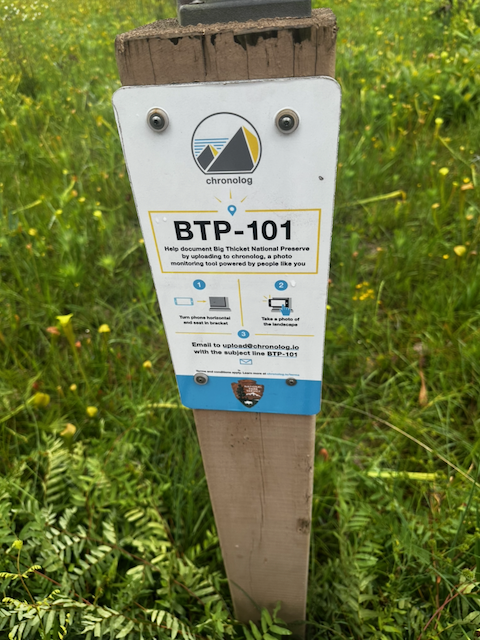
BTP-101 camera monitor on the Pitcher Plant Trail in Big Thicket National Preserve
BTP-101, a fixed photo-monitoring station on the Pitcher Plant Trail.
The image taken at BTP-101 on the Pitcher Plant Trail in Big Thicket National Preserve
The image taken at BTP-101: a single modern observation added to a longer record.
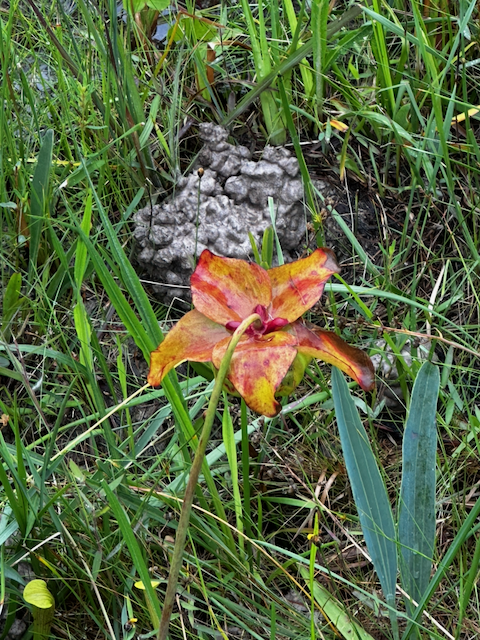
A flower of a pitcher plant next to a crawfish mound in Big Thicket National Preserve
A pitcher plant flower beside a crawfish mound: wetland neighbors in miniature.

Closing note

One Quiet Mile

After nearly one hundred miles of travel, the walk itself measured only a mile. That imbalance became part of the charm: two hours by automobile to reach a place where a careful observer might spend the rest of the day studying a few feet of wet ground.

Cynthia and I left with photographs, notes, and the sense that Big Thicket had revealed only a portion of itself. We found pitcher plants, sundews, butterworts, and signs of the lives that use them. We did not find the bladderworts.

That gives us a reason to return.

Big Thicket National Preserve NPS Pitcher Plant Trail Carnivorous Plants Brochure

Contact Us:

Lower Trinity Basin Master Naturalist
501 Palmer Street
Liberty, TX  77575
Phone: (936) 334-3230
Email: [email protected]

The Lower Trinity Basin Chapter is a program of the Texas Master Naturalist™, which is a 501(c)(3) non-profit organization. The mission of the Lower Trinity Basin Chapter of the Texas Master Naturalist Program is to develop and certify a group of well-informed volunteers to provide education, outreach, and service dedicated toward the beneficial management of natural resources and natural areas within our community. For more information on our tax-exempt status, please contact Chapter Treasurer.

© 2026 Texas A&M University. All rights reserved.

  • Compact with Texans
  • Privacy and Security
  • Accessibility Policy
  • State Link Policy
  • Statewide Search
  • Veterans Benefits
  • Military Families
  • Risk, Fraud & Misconduct Hotline
  • Texas Homeland Security
  • Texas Veterans Portal
  • Equal Opportunity
  • Open Records/Public Information